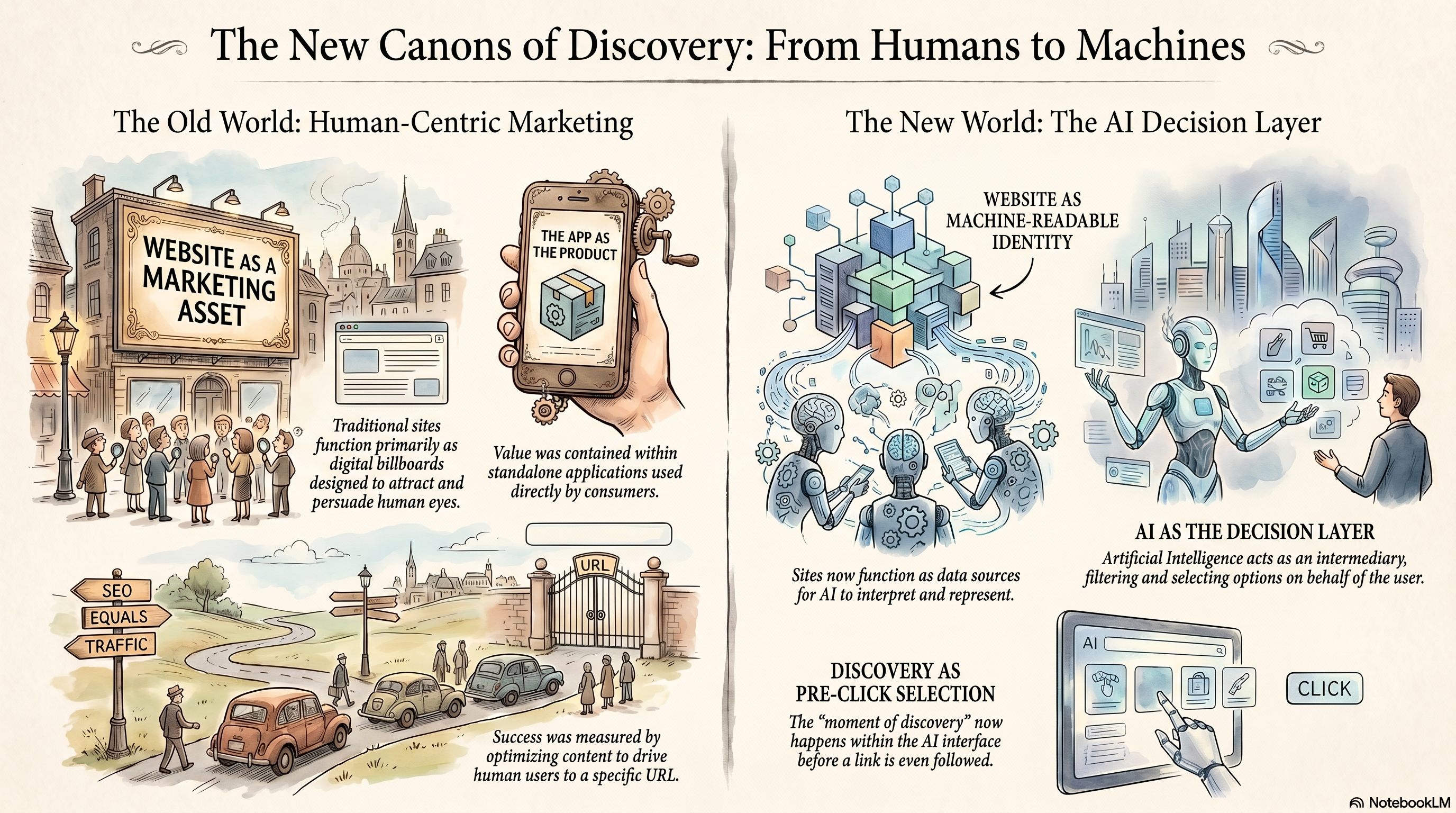
For most of the last decade, discovery worked like this: a human typed something into a search bar, scanned a list of blue links, and clicked. The job of marketing was to win that click — to get into the results, and then to persuade. The website was the billboard. The app was the destination.
That model is giving way to something different.
The Old World: Human-Centric Marketing
Before 2023, the dominant digital model treated a website as a conversion billboard: SEO drove organic traffic to a target URL, and click-through rate and session depth were the headline KPIs. Google Search commanded roughly 93% of global search volume during this period [StatCounter, 2022], making rank-position the single most valuable real-estate metric in digital marketing.
That entire mechanic assumed a human intermediary — one who searched Google, scanned ten blue links, and chose where to click.
The New World: The AI Decision Layer
In the new world, an AI acts as the intermediary — filtering and selecting options on behalf of the user. The website is no longer primarily a persuasion tool for humans; it is a data source for AI to interpret and represent. Discovery now happens as pre-click selection: the moment a brand enters or exits consideration happens inside the AI interface, before a link is ever followed.
The practical consequence is binary exclusion: if a brand's website cannot be parsed by crawlers feeding systems like ChatGPT, Google Gemini, or Perplexity, that brand is dropped from the AI-generated shortlist before a single human comparison begins. A 2024 BrightEdge study found that AI Overviews cite fewer than 10% of pages that rank in Google's top ten [BrightEdge, 2024], underscoring how narrow the selection window actually is.
What changes for your brand
By 2025, a website must serve two masters: human visitors converting through traditional funnels, and AI systems — including Google Gemini, ChatGPT, and Perplexity — mining it as a structured evidence base when generating answers.
- Clear, factual language that a model can quote and paraphrase
- Stable URLs and consistent naming so your identity is unambiguous across the web
- Structured data (Schema.org) that makes your claims machine-readable
- Sufficient depth — product details, FAQs, use cases — that the model has something concrete to work with
The competitive shift is not from marketing to engineering — it is from single-audience to dual-audience communication. As of 2025, Gartner projects that AI-powered interfaces will handle 30% of global web browsing sessions by 2026 [Gartner, 2024], meaning brands that structure content for both human readers and LLM retrieval pipelines will be cited more frequently, framed more accurately, and surfaced more consistently than those that do not.